

Does Professional Upholstery Cleaning Work? What Comes Out and What Does Not
Does professional upholstery cleaning work? What comes out, what stays, couch drying time and pet odor, Seattle area. Text for a written price.
By Yuri and Tatiana, owners of Shining Cleanse LLC, a family cleaning company based in Everett, WA and licensed in 10 cities across Snohomish and King County.
Yes, professional upholstery cleaning works on everyday soil: body oils on the arms and headrests, food and drink spills, dust and pet hair. It does not reverse sun fading or worn fabric, and old dye stains, ink and set-in water rings usually stay. Expect a cleaner, fresher piece that dries in 2–6 hours, not a new one.
That summary comes from the way we run upholstery cleaning: fabric code first, a hidden test spot, then low-moisture extraction with extra dry passes. Below is a stain-by-stain breakdown, what cleaning cannot fix, drying time, and when pet odor treatment is worth adding.
What stains come out of a couch?
Most everyday soil comes out. Set-in color and damage do not. This table covers the common situations on fabric sofas and chairs:
| What is on the fabric | Usual result | Why |
|---|---|---|
| Body oils on arms, headrests, seat fronts | Comes out or improves a lot | Pre-treatment breaks down oil, extraction rinses it out |
| Food and drink spills, recent | Most come out | Still mostly on the fiber surface |
| Dust and general gray soil | Comes out | Vacuuming plus extraction removes it |
| Pet hair | Comes out | Vacuuming first, then extraction picks up the rest |
| A ring from a store spray | Often evens out | Cleaning the whole panel removes the edge line |
| Pet urine on the cushion cover | Often improves | Needs a separate treatment, see below |
| Pet urine deep in the foam | May not fully come out | The foam core holds it below where cleaning reaches |
| Old dye stains (red drinks, colored markers) | Often stays | The dye has bonded with the fiber |
| Ink | Usually stays | Ink is a dye, not dirt |
| Old water rings that were already there | Often stays | The mark may already be set in the fiber |
| Sun fading | Stays | Lost color cannot be cleaned back |
| Worn, pilled or crushed fabric | Stays | That is wear, not dirt |
We photograph anything in the “stays” rows before we start and tell you which spots we expect to improve. We do not promise removal of any specific stain or odor.
How do you deep clean an upholstered couch?
A proper deep clean follows a fixed order, whether a professional does it or you do it carefully yourself. Low-moisture extraction is the method: a small amount of cleaning solution goes into the fabric and is pulled straight back out with the soil, using as little water as the fabric allows.
Our sequence on every fabric piece:
- Read the cleaning code on the tag and identify the fiber.
- Test a hidden spot with the exact product and temperature we will use. If color transfers to a white cloth, we stop.
- Vacuum every surface, the seams, and under the cushions.
- Pre-treat the arms, headrests and seat fronts.
- Extract at low pressure and low moisture, one full panel at a time so there are no water rings.
- Finish with extra dry passes, groom the pile, and set an air mover.
If you clean at home, the same rules protect the couch: check the code first, test in a hidden spot, use as little liquid as possible, clean whole panels rather than one spot, and blot rather than rub. La-Z-Boy’s care guide recommends frequent vacuuming or light brushing to remove dust and grime, and a professional cleaning service once the piece is soiled overall. The biggest home mistake is too much water. It soaks the cushion, takes a long time to dry, and can leave rings or brown marks.
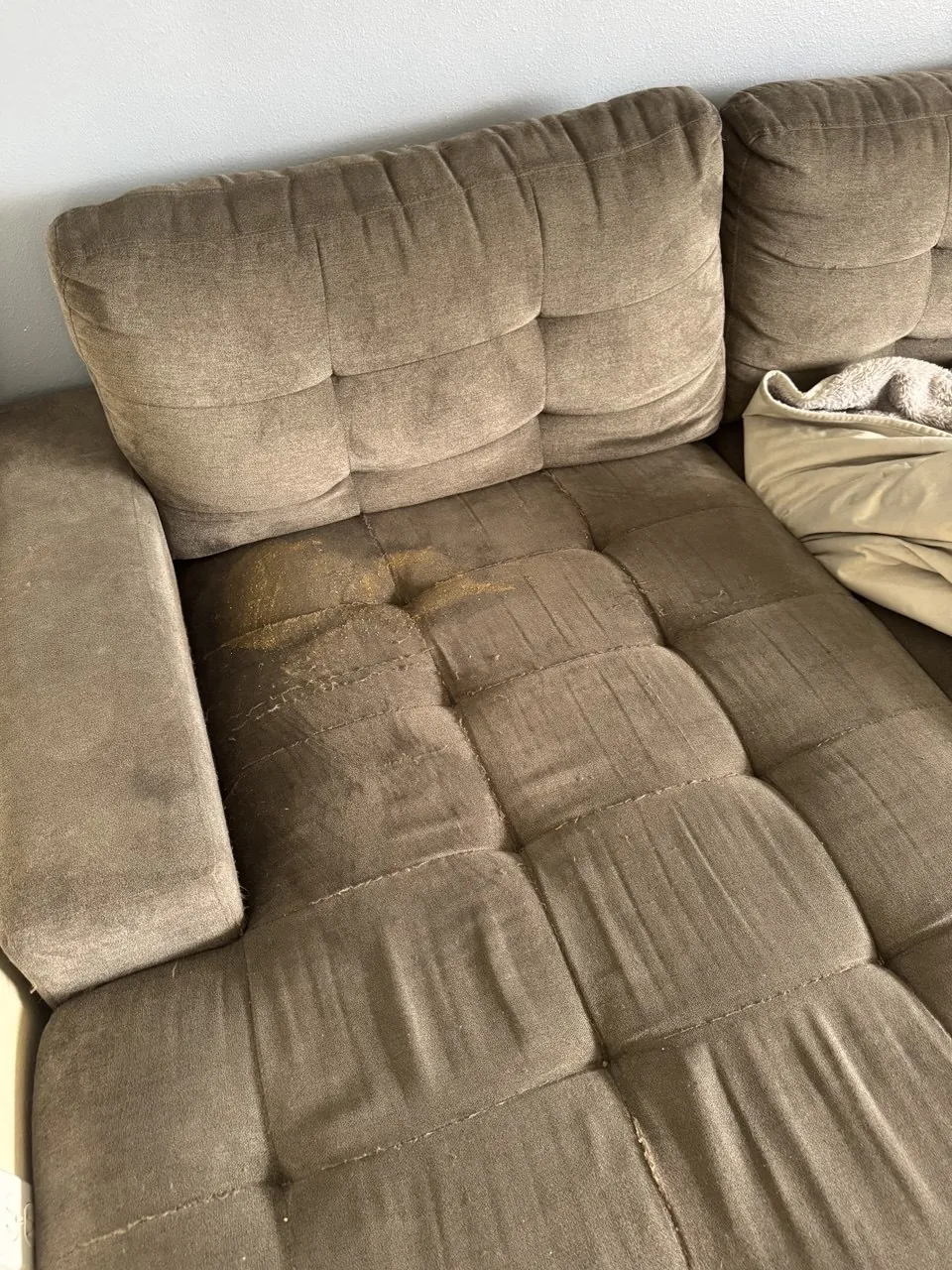 Before
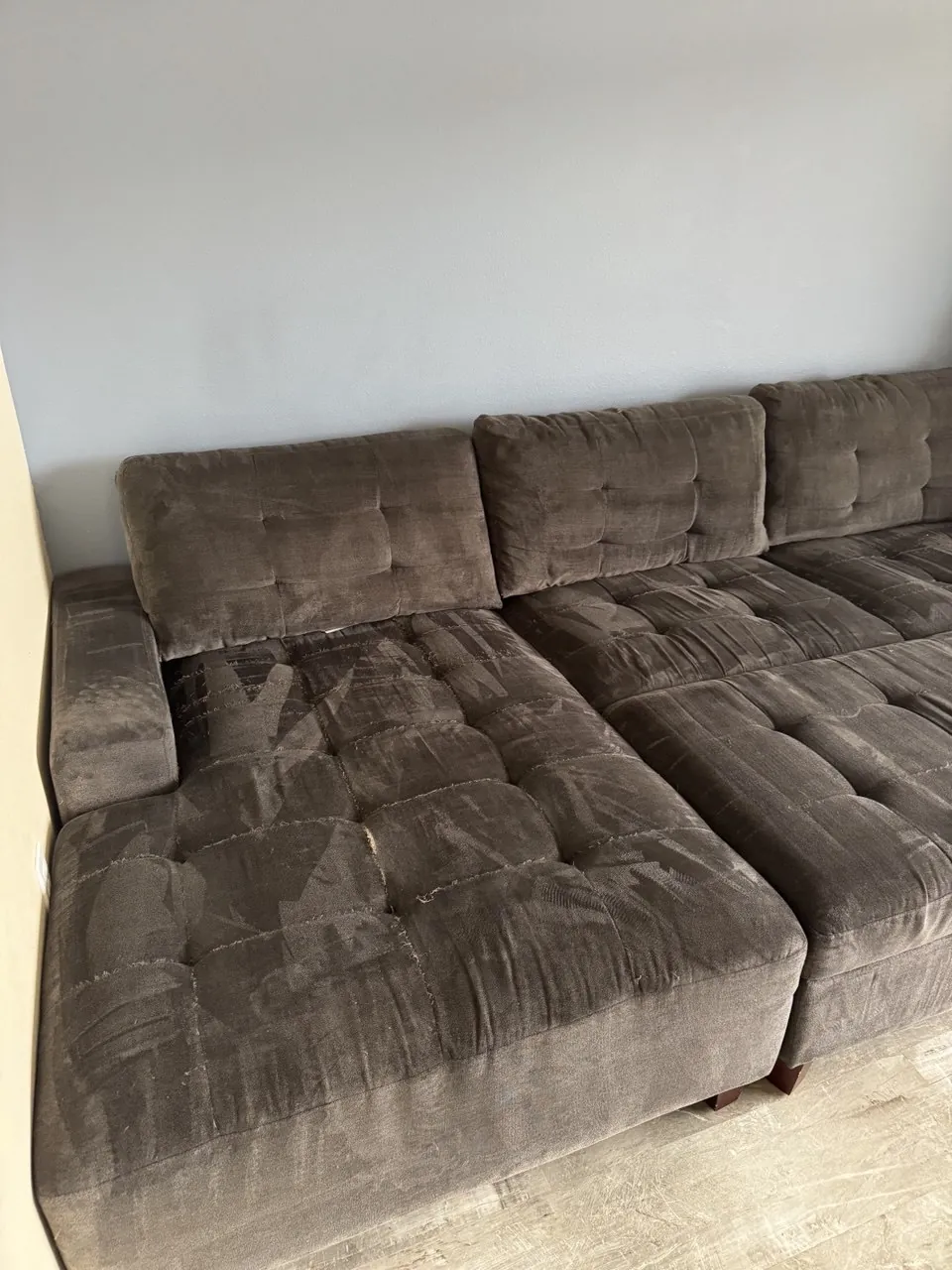 After
What does upholstery cleaning not fix?
Cleaning removes soil. It does not repair fabric or replace lost color. The limits:
- Sun fading, common on the side of a sofa that faces a window. The color is gone, not covered.
- Wear. Pilling, shine on the arms, crushed pile and thin spots stay after cleaning. They often look better because the soil is out, but the fabric is still worn.
- Color loss. Old urine and bleach can remove dye. A pale spot is missing color, and cleaning cannot put it back.
- Fiber reactions. Cotton and linen can brown with moisture, viscose can shrink, and unstable dyes can bleed. We test first and tell you before we start if your piece carries that risk.
- Water and flood damage. A couch that sat wet after a leak or flood is a different problem. Washington’s Department of Health advises that water-damaged carpets and upholstered furniture be cleaned and dried within 24 to 48 hours. We do not do flood or mold work; we refer you to a restoration company.
We also do not claim to remove dust mites, allergens or bed bugs.
How long does a couch take to dry after cleaning?
Usually 2–6 hours. Do not sit on the piece or cover it until it is dry, and stand loose cushions on edge with a fan pointed at them if you can. We use as little water as the fabric allows and finish with dry passes, which keeps drying short.
Drying is slower when the room is cold and damp, so keep the heat at its usual setting, open a window if it is dry outside, and let air move across the fabric. If the piece still feels damp after 6 hours, add a fan. Do not use a hair dryer or space heater close to the fabric.
Does upholstery cleaning remove pet odor?
Often, if the urine is on the surface of the cushion cover. Tell us where the pet has been, because old spots are often hard to see in daylight; we also check the fabric by smell. Urine is not dirt. It leaves salts and uric acid that normal upholstery detergent does not break down, so it needs its own treatment: an enzyme or oxidizing product left for its full dwell time, then extraction. That is our pet odor treatment, $52 per affected area, added to the upholstery clean.
If the urine soaked into the foam core, surface treatment reduces the smell but may not remove it. We say so in the quote. For keeping hair and smells under control between cleanings, see our guide to keeping a fabric couch clean with pets; for accidents on carpet, read pet urine carpet treatment. If the smell in the room is musty rather than pet, the source may be the carpet or the room itself, which we cover in musty carpet smell in Pacific Northwest homes.
Which fabrics should not be cleaned with water?
Fabrics coded S or X on the tag, plus a group of delicate materials. With us, S and X fabrics get dry vacuuming only, and liquid only with your written OK and at your risk. We do not clean leather, suede, nubuck, silk, velvet, viscose or antique pieces at this stage; we refer you to a specialist.
If you are not sure what your tag means, our guide to upholstery cleaning codes W, S, WS and X explains each letter and where to find it.
Is professional upholstery cleaning worth it?
It is worth it when the piece is soiled overall, smells stale, or has spots you could not remove without risk. For a home with kids and pets, once a year is a sensible rhythm.
Our prices: loveseat $129, sofa $169, sectional $236 for 4–5 seats or $266 for 6 or more, armchair $89, with a $180 visit minimum. A single loveseat is billed at the minimum, so adding it to a carpet visit is the better value; our guide to sectional couch cleaning cost shows example totals. Prices include travel within our ten licensed cities, including Woodinville.
If a spot comes back as the fabric dries, text us within 48 hours with a daylight photo and we come back to re-treat that area at no charge.
 Our job
FAQ
Can professional cleaning make a couch stain worse?
It can if the wrong product or too much water is used, which is why we read the code and test a hidden spot first. Stains already set by heat or a store spray are harder to move, so tell us what has been tried on them.
Will my couch smell after it is cleaned?
While it dries, the fabric can smell faintly damp; that fades as it dries. We do not use masking fragrances, and fragrance-free products are available on request. If a smell stays after the piece is fully dry, text us; it can come from the cushion foam.
Do I need to vacuum my couch before the cleaners arrive?
No. Dry vacuuming every surface, the seams and under the cushions is our first step. Just clear blankets, toys and anything stored under the cushions, and make sure we can reach an outlet.
Get a written price
Text 2–4 photos to (425) 539-5492 or request a written quote: the whole piece, the tag under a cushion and close-ups of the spots, plus what has already been used on them. We reply with a written price the same business day (Mon–Fri 9am–7pm, Sat 9am–5pm).
upholstery cleaningcouch cleaningstainspet odordrying timedoes professional upholstery cleaning work